

The State of Online Engagement in Higher Education
A national survey of higher ed leaders reveals what's working, what's falling short, and where institutions are investing next.
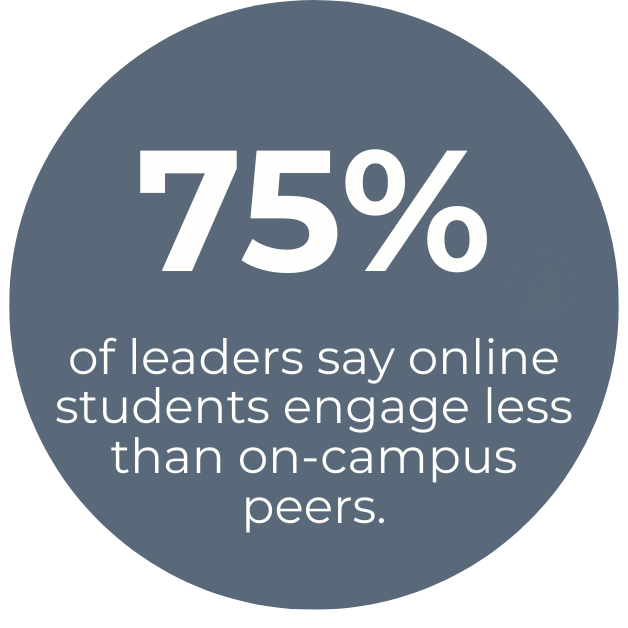
75% of higher ed leaders say online students engage less than their on-campus peers. So what's getting in the way?
This report cuts through the noise with real data from administrators across the country — revealing the strategies gaining traction, the gaps that persist, and where institutions are investing next. Whether you're refining your current approach or building something new, this is the benchmark you've been missing. Download the free report below.
Get the Free 2026 Report

WHAT’S INSIDE THE REPORT
A full picture of the engagement landscape
The online vs. in-person engagement gap
Why the gap persists and how it varies by institution type and size.
Barriers institutions face
Staff capacity, funding, silos, and the compounding problem of engagement fatigue.
What actually works
The Personalized Persistence Framework TM. InScribe's model for building student engagement that scales, built around four layers of intentional support that reduce isolation, build belonging, and improve retention.
Engagement in action
Case studies from NAU, Fort Hays State, UNT, and WGU Academy with measurable outcomes.
INSTITUTIONS LEADING THE WAY
Connection, when structured, drives real results

66%
Of new residential students engaged with the Virtual Advising Hub in the fall term.

1,000+
Active participants in Tiger-2-Tiger digital community within months of launch.

+13%
Increase in persistence among virtual community participants since launch.
THIS REPORT IS PART OF A 2-PART SERIES
Bridging the Engagement Gap in Online Education
Before diving into the survey data, get grounded in the framework behind it. Our 2025 guide, Bridging the Engagement Gap in Online Education, walks through why social capital matters, what makes digital communities work, and how institutions like Rio Salado College and Western Governors University are already seeing results. Then come back to this report to see how institutions across the country are applying — or struggling to apply — these same principles at scale.

ABOUT THE SURVEY
This report is grounded in responses from higher education administrators across the country, collected via an online survey distributed to more than 15,000 higher ed leaders in InScribe's network and promoted through LinkedIn. All responses were collected confidentially and analyzed in aggregate.
Who responded: Respondents came primarily from public and private four-year institutions, with representation from community colleges and technical and vocational schools. Institutions ranged in online enrollment from under 5,000 to more than 25,000 fully online students, reflecting a broad cross-section of program scale and institutional context. The majority of respondents held senior leadership roles — including Provost, Dean, Vice President, and Director — with oversight spanning Student Affairs, Academic Affairs, and Online Learning.
What we asked: The survey covered three core areas: how institutions currently prioritize and approach student engagement, what strategies and platforms they are using for both on-ground and online learners, and what barriers are limiting their ability to implement or scale engagement efforts. Respondents also shared open-ended perspectives on what's working, what's falling short, and where they expect to invest next.
Ready to see where your institution stands?
The 2026 State of Online Engagement report is free for higher education professionals. Inside you'll find the full survey data, case studies from institutions already closing the engagement gap, and a practical roadmap for building engagement that actually scales.